
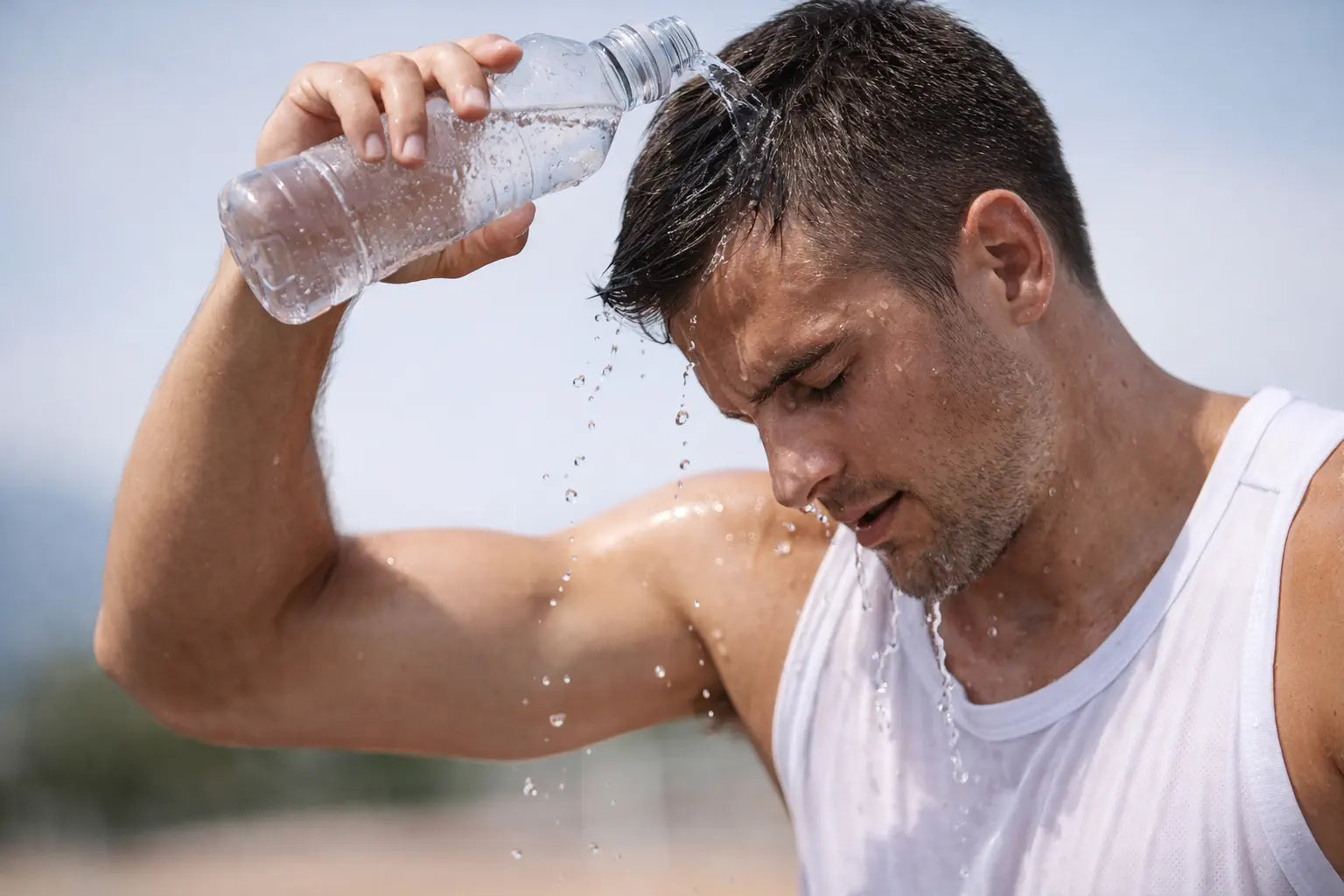
How do electrolytes control hydration?
Electrolytes control hydration by governing how water moves between your intestines, bloodstream, and cells. Sodium drives water absorption in the gut and maintains blood volume, while potassium, magnesium, and calcium regulate cellular hydration, muscle function, and circulation during exercise and heat stress. Effective hydration requires replacing electrolytes at sweat-loss levels, not trace amounts—water alone cannot restore fluid balance when electrolytes are lost through sweat.
TL;DR
- Hydration isn’t just about drinking water — electrolytes determine whether water is absorbed and retained
- Sodium is the primary driver of fluid absorption in the gut and plasma volume retention
- Sweating removes specific electrolytes, not just water
- Potassium, magnesium and calcium support cellular hydration, muscle and nerve function
- Sugar is not required for hydration in healthy people
- Effective hydration requires replacing all major electrolytes lost in sweat, not single-electrolyte or sugar-based solutions
Introduction
Here's the thing about hydration: it's not just about drinking more water.
Most people assume that chugging water after a sweaty workout or a hot day on the tools will sort them out, but the science tells a different story. When you sweat, you lose more than water—you lose electrolytes that actually control whether that water gets absorbed, stays in your body, or just passes straight through. (Explained in detail in what you actually lose in sweat).
Electrolytes determine whether water is absorbed and retained — water follows electrolytes, not the other way around.
Let's dive into how electrolytes truly govern hydration, why water alone falls short, and what your body actually needs to recover properly.
How Sodium Drives Water Absorption in Your Gut
Your small intestine absorbs around 8 litres of fluid per day, but it doesn't do this through simple diffusion. Instead, water follows sodium—specifically through active transport mechanisms that pull hundreds of water molecules along with each sodium ion.
Research shows that The SGLT1 transporter couples sodium, glucose, and water movement across the intestinal wall with strict stoichiometric precision. This is the molecular foundation of oral rehydration therapy and explains why sodium-containing drinks deliver fluid more effectively than water alone during or after exercise.
Other transport systems (sodium–amino acid cotransport, sodium–chloride absorption) also contribute. However, sodium remains the dominant ion driving intestinal water uptake. This is why effective electrolyte replacement focuses on sodium content first.
Why Water Alone Doesn't Work After Sweating
Plain water is absorbed quickly—but it's poorly retained when you've lost electrolyte-rich sweat.
Here's what happens: During exercise or physical work, you lose substantial sodium in sweat. Total sweat sodium and chloride losses can increase by about 150% as exercise intensity rises. When you replace this sodium-rich fluid with plain water, your plasma becomes relatively diluted (hypo-osmotic), which suppresses vasopressin (the hormone that tells your kidneys to hold onto water). The result? Much of that water you just drank gets excreted as urine, and your plasma volume recovers incompletely.
Research consistently shows that sodium-containing beverages produce greater plasma volume expansion and higher fluid retention over several hours than equal volumes of water. Across hydration studies, sodium content—more than carbohydrate content—predicts long-term fluid retention and hydration status.
This is why water alone cannot restore fluid balance when electrolytes are lost through sweat. Your body doesn't just need volume—it needs the right composition.
What You Actually Lose in Sweat (And Why It Matters)
Sweat isn't just water with a bit of salt. It's a complex fluid containing meaningful amounts of sodium and smaller but significant amounts of potassium, magnesium, and calcium.
The sweat loss reality
On average most people lose 800mg of sodium per litre of sweat, plus physiologically meaningful amounts of potassium, magnesium, and calcium—not just trace amounts. These losses increase substantially with exercise intensity, heat exposure and sweat rate, and individual variation is enormous. Some heavy, salty sweaters can lose several grams of sodium per hour.
Consequences for Your Body
Reduced plasma volume: Loss of sodium-rich fluid decreases extracellular volume, increasing cardiovascular strain and impairing your body's ability to regulate temperature.
Risk of hyponatremia:
If high sweat sodium losses are replaced primarily with low-sodium fluids or plain water, plasma sodium can fall dangerously low (exercise-associated hyponatremia), shifting water into cells, including brain cells, with serious neurological risk.
Cellular dehydration
When both water and sodium intake are insufficient, plasma osmolality rises and water leaves your cells to support blood volume, leading to intracellular dehydration, cramps, and fatigue.
Absorption vs Retention: Two Distinct Processes That Both Matter
Most people think absorption and retention are the same thing. They're not.
Absorption is the movement of water and electrolytes from your intestine into your bloodstream. It's driven by sodium transport (primarily with glucose and other nutrients) and local osmotic gradients.
Retention is your body's ability to keep that absorbed fluid over time, rather than rapidly excreting it through your kidneys.
Why the Difference Matters
A low-solute drink like plain water can be absorbed very quickly but may lower plasma osmolality and trigger rapid urination, reducing retention (net hydration). A drink with adequate sodium may absorb slightly more slowly yet better maintain plasma osmolality and hormonal responses (vasopressin, renin–angiotensin–aldosterone system), leading to greater net fluid retention and plasma volume restoration.
This principle is demonstrated clearly in Beverage Hydration Index research, where drinks containing sodium are retained better than water over several hours, even when total intake is the same.

The Four Electrolytes That Control Hydration
Sodium: Extracellular Volume and Plasma Volume
Sodium is the main extracellular cation and the dominant determinant of extracellular fluid osmolality and volume. During and after exercise, sodium-containing drinks limit falls in plasma sodium concentration, better preserve plasma volume, and support cardiovascular stability compared with water.
In your intestine, sodium-glucose (and sodium–amino acid) cotransport drives large water fluxes, forming the physiological basis of oral rehydration solutions used in both clinical and exercise settings.
Potassium: Intracellular Hydration and Membrane Potential
Potassium is the primary intracellular cation and crucial for resting membrane potential, nerve transmission, and muscle contraction. Exercise causes potassium to shift from muscle cells into the extracellular space and into sweat; higher intensity increases total potassium losses substantially.
Adequate potassium intake during recovery helps restore intracellular potassium content and supports cellular osmolality, which helps water remain within cells after rehydration. Optimal hydration requires replacing all major electrolytes lost in sweat—sodium, potassium, magnesium, and calcium—not just sodium alone.
Magnesium: Ion Pumps, Muscle Function, and Vascular Tone
Magnesium is a cofactor for ATP-dependent enzymes, including the Na⁺/K⁺-ATPase that maintains sodium and potassium gradients across cell membranes. While acute sweat magnesium losses are modest, repeated high-volume sweating with low dietary magnesium can contribute to neuromuscular dysfunction and cramping.
Magnesium also influences vascular tone and endothelial function, affecting blood flow and pressure responses during exercise and heat exposure—indirectly supporting appropriate distribution and retention of fluid.
Calcium: Muscle Contraction and Circulatory Stability
Calcium is central to excitation–contraction coupling in skeletal and cardiac muscle, and to neurotransmitter release. It's lost in sweat at lower concentrations than sodium but still measurably, and chronic high sweat losses without adequate dietary calcium may contribute to musculoskeletal issues over time.
Calcium also participates in vascular smooth-muscle contraction and interacts with hormonal systems that regulate blood pressure and volume, supporting circulatory stability during and after rehydration.
Do You Actually Need Sugar for Hydration?
Here's where things get interesting—and where most commercial sports drinks get it wrong.
The classic World Health Organization oral rehydration solution uses glucose because the SGLT1 transporter requires luminal glucose to maximize sodium-linked water transport in severe diarrhoeal disease. In that life-threatening clinical context, sodium–glucose cotransport is critical for survival.
But in healthy people during exercise or work in the heat, the story is different.
Studies manipulating beverage glucose and sodium show that sodium content is the main determinant of total fluid delivery and retention. Very high carbohydrate concentrations (above 6–8%) can actually slow gastric emptying and reduce overall fluid delivery.
Research shows that sugar is not required for electrolyte absorption—sodium and glucose work independently in fluid transport. A systematic evaluation of beverage composition for hydration concludes that sodium and overall electrolyte content drive hydration outcomes, while carbohydrate can be titrated mainly for energy needs rather than for basic fluid absorption.
Sugar is not required for electrolyte absorption in healthy individuals. Sodium and other electrolytes alone create the osmotic and transport forces needed to pull water across the intestinal wall. Carbohydrate may be useful as an energy source for very high-intensity or long-duration efforts, but it's not intrinsically required for the core mechanisms of electrolyte absorption and fluid retention in healthy individuals.
What Most Hydration Products Get Wrong
Many hydration products focus on a single electrolyte — or the wrong one — rather than replacing what is actually lost in sweat.
The Potassium Problem (Coconut Water and Similar Drinks)
Coconut water and other “natural” hydration drinks are often marketed as electrolyte-rich because they contain relatively high amounts of potassium. While potassium is important for cellular function, it is not the primary electrolyte lost in sweat and it does not drive fluid absorption or retention on its own.
Sweat losses are dominated by sodium, not potassium. When sodium losses are not adequately replaced, fluid absorption in the gut is reduced and much of the water consumed is rapidly excreted. A drink that is high in potassium but low in sodium may taste refreshing, but it does not reliably restore plasma volume after sweating.
Potassium supports hydration — but it cannot replace sodium’s role.
Sugar-Focused Formulations
Many commercial sports drinks rely on sugar to improve flavour or follow outdated clinical rehydration models designed for severe illness. In healthy people, sugar is not required for electrolyte absorption and can impair hydration by slowing gastric emptying or contributing unnecessary energy.
Sugar may play a role as fuel during prolonged, high-intensity exercise, but it is not essential for the core mechanisms of hydration.
Where High-Sodium, Single-Electrolyte Drinks Fall Short
Some hydration products swing the opposite way — delivering very high amounts of sodium, but little to none of the other electrolytes lost in sweat.
While sodium is the primary driver of fluid absorption and plasma volume, hydration does not end there.
Sweat losses follow a consistent pattern:
-
Sodium is lost in the greatest amount
-
Potassium, magnesium and calcium are lost in smaller but still physiologically meaningful quantities
Replacing sodium alone may improve short-term fluid absorption, but it does not fully support cellular hydration, neuromuscular function or recovery when sweating is prolonged or repeated.
Over time, consistently replacing only sodium while neglecting other electrolytes can leave intracellular balance incomplete — particularly for people training frequently, working long hours in the heat or restricting dietary intake.
Sodium is necessary for hydration, but it is not sufficient on its own.
The Real Issue: Incomplete Replacement
The formulation mismatch is clear:
your body loses specific electrolytes in meaningful and predictable ranges — not trace amounts.
Effective hydration means:
-
Prioritising sodium at sweat-loss levels
-
Supporting cellular hydration with potassium
-
Including magnesium and calcium for neuromuscular and circulatory stability
Many products over-emphasise potassium, under-deliver sodium or rely on sugar — leaving the fundamental problem unsolved.
Sodium drives hydration, but full electrolyte replacement requires potassium, magnesium and calcium to support cellular and neuromuscular balance.
Hydration works best when electrolyte replacement reflects how the body actually loses fluid through sweat — not how drinks are traditionally marketed.
How This Science Is Applied in Practice
When hydration is built around real physiology, the goal is simple: replace what sweat actually removes so water can be absorbed and retained effectively.
In practice, that means a formulation that:
- Replaces sodium at sweat-loss levels, rather than trace amounts
- Includes potassium, magnesium and calcium at physiologically meaningful concentrations
- Prioritises electrolyte-driven absorption and fluid retention rather than sugar
- Focuses only on ingredients that directly support hydration mechanics
- Is designed for meaningful sweat loss from heat, exercise and physical work
Purelyte is one example of a formulation built around these principles. It’s not about flavour, stimulation or added energy — it’s about aligning electrolyte replacement with how the body actually absorbs and retains fluid after sweating.
Key Takeaways
- Effective hydration requires replacing electrolytes at sweat-loss levels, not trace amounts—water alone cannot restore fluid balance.
- Sodium drives water absorption in the gut and determines plasma volume retention; it's the primary electrolyte for hydration.
- Most people lose ~800mg of sodium per litre of sweat, plus meaningful amounts of potassium, magnesium, and calcium.
- Optimal hydration requires replacing all major electrolytes lost in sweat—sodium, potassium, magnesium, and calcium—not just sodium alone.
- Sugar is not required for electrolyte absorption—sodium and glucose work independently in fluid transport.
Frequently Asked Questions
Q: Why can't I just drink more water after exercising?
A: Water alone is poorly retained when you've lost electrolyte-rich sweat. It can actually dilute your plasma, suppress the hormone that helps retain water, and cause you to urinate out much of what you drink. Effective hydration requires replacing both water and electrolytes.
Q: How much sodium do I actually need to replace?
A: Most people lose 800-1200mg of sodium per litre of sweat. A 90-minute training session producing 1-2 litres of sweat means you've lost 1600-2400mg of sodium that needs replacing.
Q: Is sugar necessary for hydration?
A: No. Sugar is not required for electrolyte absorption in healthy people. Sodium and other electrolytes drive fluid absorption and retention independently. Sugar may provide energy but isn't needed for the core hydration mechanisms.
Q: What about potassium, magnesium, and calcium—do they matter?
A: Yes. While sodium is the primary driver, optimal hydration requires replacing all major electrolytes lost in sweat. Potassium supports cellular hydration, magnesium powers ion pumps and muscle function, and calcium supports muscle contraction and circulation.
Q: Why do most sports drinks have sugar?
A: Most commercial sports drinks add sugar for taste, energy, and to follow outdated clinical rehydration formulas designed for severe illness, not healthy exercise. In non-clinical settings, sodium and electrolytes drive hydration—sugar is optional.
References
- Maughan RJ, Leiper JB. Sodium intake and post-exercise rehydration in man. Eur J Appl Physiol Occup Physiol. 1995;71(4):311-9.
- Loo DD, et al. Water pumps. J Physiol. 1996;496(Pt 1):93-102.
- Shirreffs SM, Sawka MN. Fluid and electrolyte needs for training, competition, and recovery. J Sports Sci. 2011;29 Suppl 1:S39-46.
- Baker LB, et al. Sweating rate and sweat sodium concentration in athletes: a review of methodology and intra/interindividual variability. Sports Med. 2017;47(1):111-28.
- Jeukendrup AE, Moseley L. Multiple transportable carbohydrates enhance gastric emptying and fluid delivery. Scand J Med Sci Sports. 2010;20(1):112-21.
- Loo DD, et al. Passive water and ion transport by cotransporters. J Physiol. 1999;518(Pt 1):195-202.
- Gonzalez-Alonso J, et al. Dehydration markedly impairs cardiovascular function in hyperthermic endurance athletes during exercise. J Appl Physiol. 1997;82(4):1229-36.
- Osterberg KL, et al. Carbohydrate exerts a mild influence on fluid retention following exercise-induced dehydration. J Appl Physiol. 2010;108(2):245-50.
- Maughan RJ, et al. A randomized trial to assess the potential of different beverages to affect hydration status: development of a beverage hydration index. Am J Clin Nutr. 2016;103(3):717-23.
- Sawka MN, et al. American College of Sports Medicine position stand. Exercise and fluid replacement. Med Sci Sports Exerc. 2007;39(2):377-90.
- Almond CS, et al. Hyponatremia among runners in the Boston Marathon. N Engl J Med. 2005;352(15):1550-6.
- Santosham M, et al. Oral rehydration therapy of infantile diarrhea. N Engl J Med. 1982;306(18):1070-6.
- WHO. Oral rehydration salts (ORS): a new reduced osmolarity formulation. 2002.
Share:
Why Sugar Isn’t Required for Effective Hydration